In this episode of The Product Angle Show, we chat all things roadmaps and best practices with Liz Love of ProdPad.
By the end of the episode you’ll learn:
What is a roadmap (purpose and goals)?
What are some of the important inputs that go into a roadmap?
Current trends with regards to roadmaps.
Watch the roadmap best practices episode
Roadmap best practices
What is a roadmap?
The roadmap is a way of sharing strategy with stakeholders/customers. It’s the what/why of your plans, rather than the when/how/who (which is project management). It’s a living document that is adapted over time to ensure your strategy is always aligned with how you’ll reach your vision and objectives.
What are some of the important things that go into a roadmap?
It’s really important to have a clear definition of the problems you’re solving, and why. It’s not about showing a list of features, it’s about saying who you’re planning to help, and why.
So what if you’re adding a new AI feature to your product.
Why are you doing it?
Who will it help?
What’s the point for your customers and also for your own business?
For Liz, knowing why you’re planning to make a change is the most important thing. It can fundamentally change what feature you decide to build. Liz has hit this situation in her PM past, where PM’s changed their approach to solving a problem when they learned more about it.
It was painful, PM’s threw away work we’d already done, but the resulting solution was MUCH better as a solution, and long-lasting too.
What trends are you seeing with regards to roadmaps?
Liz is seeing more people understand the comments made earlier. Liz started working for ProdPad nearly 3 years ago and spent a lot of time explaining what a good roadmap looks like. These days, while Liz still does that, she is usually preaching to the choir – people are more aware that a roadmap and a release plan are different things.
Liz is also seeing more people understand the value of linking the roadmap to goals, whether that’s OKRs or some variant.
In addition, Liz is starting to see other parts of the business realize that lean road mapping/planning is a good way to approach their work. It’s not just about building a product. It’s about productizing other functions like sales, customer success, or marketing.
What are your thoughts on roadmaps with dates on them?
Most people who know about the ProdPad way know that we highlight the dangers of roadmaps which include a timeline.
However, there’s a subtlety that isn’t always understood.
It’s less about having a date on a roadmap (which, let’s face it, is sometimes unavoidable – like when trying to meet a legal or regulatory requirement, or maybe a fixed commercial event like a conference or holiday season).
It’s more about including time in the structure of the roadmap format. As soon as there is a timeline on a roadmap, everything is naturally linked to that timeline. Using a now/next/later format (as we do in ProdPad) means the time horizons are looser and less restrictive.
It takes the focus off trying to guess the delivery of everything and instead allows you to focus on solving the right problems in the right order. Liz doesn’t see anything wrong with adding a date to an initiative that is time sensitive, but it has to be done in a way that doesn’t imply dates for all the other initiatives on the page.
What items should be on the roadmap?
Liz believes they should be phrased as a problem to solve or a hypothesis. For example “Can we increase engagement by adding a social aspect to our website?” or “Can we reduce support queries by providing more guidance?”.
These questions state the desired outcome (increased engagement, reduced support queries). It also states the suggested change in a way that doesn’t indicate a specific solution. They make it clear what problem is being solved and give the flexibility to experiment with the right solutions.
Having a roadmap that’s written in that way gives the product team the opportunity to explore, discover, and eventually arrive at a solution which gives the best outcome. You might want to phrase the initiative as a solution if you’re about to deliver it, as you’ve done the discovery and know what you’re doing – another reason to constantly adapt your roadmap as you discover more.
A product team working in that environment is more likely to create products that resonate with the market. Having an experimental mindset allows for the best possible outcomes to be reached, and reduces the risk of business failure.
What is ProdPad?
ProdPad is a product management tool that encourages a positive, lean product culture. It provides a way to define the business model, vision, and objectives associated with your products, collect feedback and ideas from stakeholders, customers, and the market and align the market needs with the business’ objectives. It’s very collaborative and encourages everyone in the company to get involved in defining the product direction. Being clear, it’s a tool that helps product teams with discovery and strategy and integrates with a bunch of other tools to enable delivery. Importantly, it covers the entire product lifecycle, not just project management.
In Closing – Roadmap best practices
Thank you, Liz, for sharing valuable information around roadmap best practices.
However, before we go thank you to the viewers for summing up the session nicely.
The “now, next, later” format might actually be one of the best formats I’ve come across to categorise the product roadmap. The final advise about ‘ask questions’ and ‘keep asking why’ will definitely help me through building @getspiti. Thank you @TheProductAngle@lizzielove 🙌🏽 https://t.co/zeZwv7PAhV
Building a roadmap is a collaborative effort. It requires input from the entire product team. However, a PM is the one who ensures the right content is in it and updates it regularly. #ProdMgmt
Hey 👋 no I mean HEY is the new email service from the Basecamp team. In this article we take a closer take look at Hey and answer the question: Hey – Is the new email service from Basecamp worth the hype?
Hey – Is the new email service from Basecamp worth the hype?
Do you remember your first email address? Way back when dial-up was a thing. My first email address was a Freeserve (I think) email. My memory is a little hazy. However, I needed Freeserve to access the internet and it came with an email address.
Later I changed my email to an AOL address and kept that for many years, even after Gmail became the standard. However, I finally gave in and jumped to Gmail when I was spending more time cleaning my spam emails than actually reading emails.
Changing email addresses takes a lot of work. Exporting, saving, or forwarding while modern tools have made it easier. However, you still need to spend some time in the process.
Also, shout out and credit to Ziyad who helped source an invite through James Hill-Khurana who kindly shared 1 of his invites with me to write this article now. 🙏
What is Hey?
What’s interesting here is that HEY is not an email client. That’s why HEY isn’t an app that sits on top of Gmail, Outlook, iCloud, Yahoo, etc. HEY is a full email service provider. You don’t use HEY to check your Gmail account, you use HEY to check your HEY account. It’s its own platform, and it’s all you’ll need.
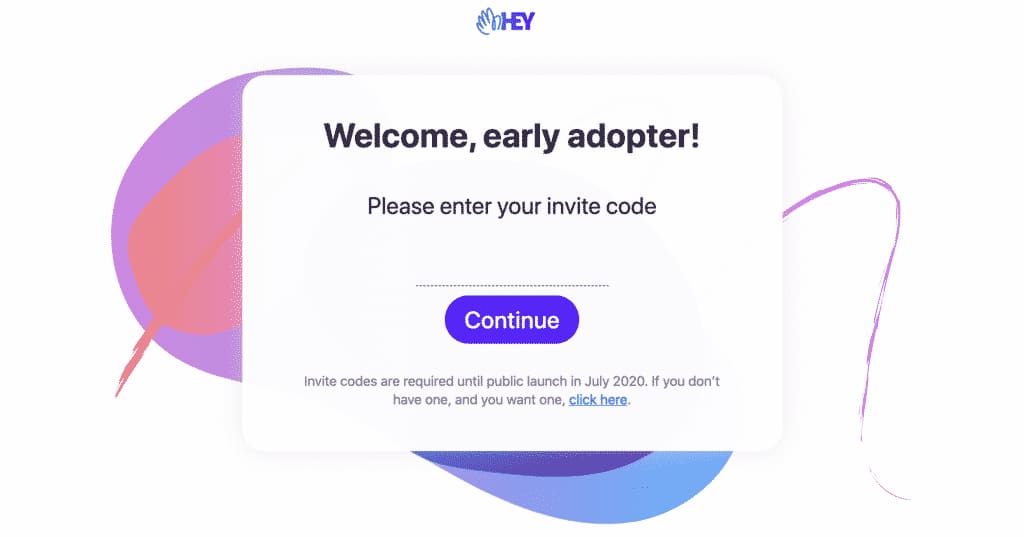
Currently, invite codes are required until their public launch in July 2020. To get a code, email iwant@hey.com and tell us how you feel about email. It could be a love story or a hate story. It could be long, could be short. It’s your story, so it’s up to you.
Email, in my opinion, is a very boring product. Somewhat functional if you will. Will HEY change that?
The last time anyone got excited about email was when Google launched Gmail back around 2005. Over 15 years ago, we’ve adapted to doing email in the status quo Gmail and Outlook way. Therefore, we have not seen any exciting developments recently.
However, if you are a Superhuman user, you might disagree. I’m not a Superhuman user, for me, I don’t have a big enough email problem that I need to spend $30 a month on. Although, some people I’ve spoken to love the Superhuman experience.
Back to Hey.
95,000 people signed up to be on a waitlist
As per the CEO of HEY Jason, the waitlist for Hey passed 95,000 people. Clearly, email is a problem people are interested in exploring to solve.
Just passed 95,500 people on the HEY wait list. We’ve sent ~30k invites so far. MAYBE we can get through the rest next week, but it’s probably more like 7-10 days more until we’ve released them all. Thanks for your patience! https://t.co/Izp2mLKH4E
To be on the waitlist you need to email hey@hey.com and tell them what email means to you. So this was not a box where you type in your email and hit submit. A little more effort is needed.
Will HEY become the defacto standard in email going forward?
Only time will tell.
HEY is a completely redesigned rethink on email and this is clear from their love letter on the homepage of HEY.
Hey everyone—
It’s 2020, we need to talk about email.
Email gets a bad rap, but it shouldn’t. Email’s a treasure.
It feels great to get an email from someone you care about. Or a newsletter you enjoy. Or an update from a service you like. That’s how email used to feel all the time.
But things changed.
You started getting stuff you didn’t want from people you didn’t know. You lost control over who could reach you. An avalanche of automated emails cluttered everything up.
Read the full love letter to email on HEY’s homepage.
How HEY works?
Since HEY is a complete rethink on email it is very opinionated on how email *should* be. I don’t plan to go through all the features of HEY. If you’re interested in all the feature HEY has to offer read the Tour Features page on HEY’s site.
A few things that come to mind:
There is no INBOX
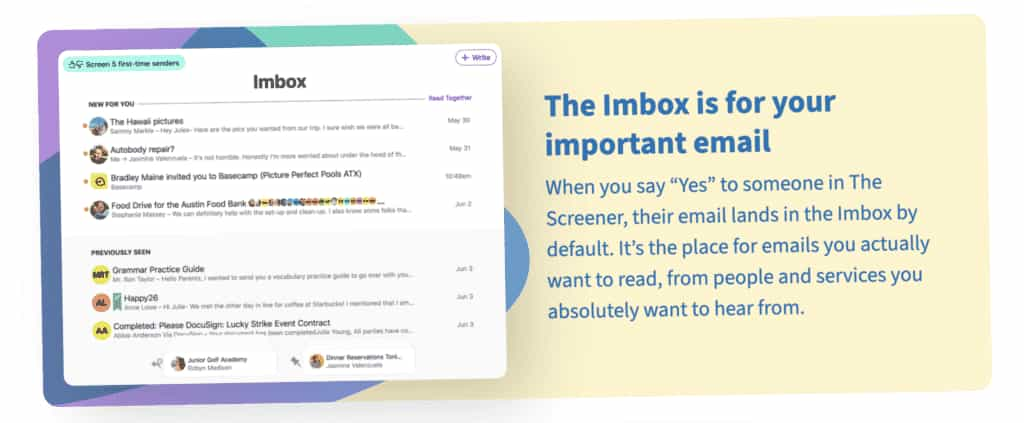
Well now it’s renamed to iMbox ok just Imbox
The Imbox screener
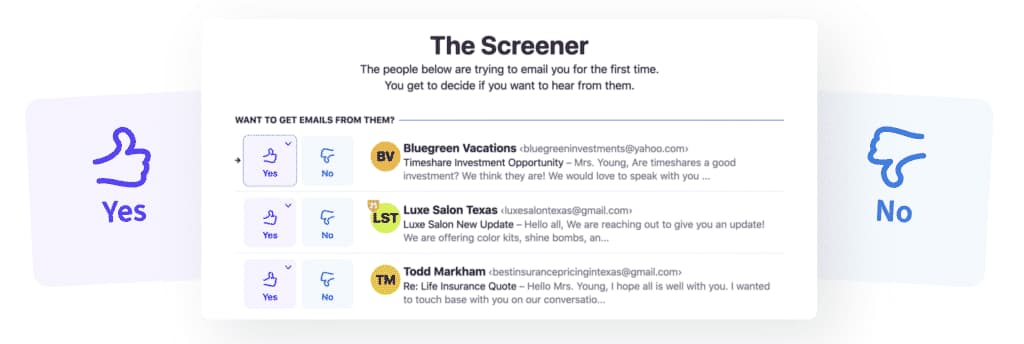
Before emails can get to your Imbox they are screened. This means the first time someone sends an email they land in the screener. You then decide if you want to “accept” the email or not (note: HEY refers to this as “where you decide if you want to hear from them or not.”)
Click yes and you’ll continue receiving their emails. Click no and you’ll never hear from them again.
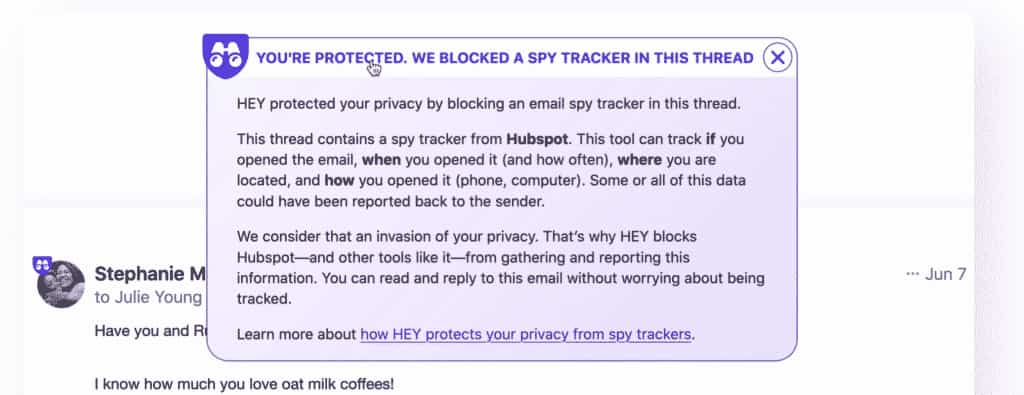
Privacy focused
Maybe I should have started here. In my opinion, this is the game-changer. Regardless of if you agree with it or not as more and more people adopt HEY you’ll likely start seeing more tweets of marketers using open tracking pixels.
The bigger question is does HEY have the chops to effectuate change or will marketers simply find ways around it?
Hey – Is the new email service from Basecamp worth the hype?
How much does it cost?
Currently as far as I know, HEY has three tiers:
$99 per year for a username that has more than two characters e.g pradip@hey.com
$349 per year for a username that has three characters e.g. pkh@hey.com
$999 per year for a user that is two characters e.g. pk@hey.com
Which got me thinking what would p@hey.com cost? (or does HEY even allow a one character email address?).
Guess I’ll never know now that been onboarded onto the system. If you are someone just receiving your invite let me know on Twitter.
[Update: James informed me that single character emails do not seem to be supported, he tried.] 🙏
i won't say i'm not tempted but $999 per year is a liiiiitle much…. i'd pay it once though 😅 pic.twitter.com/D4SPt8dwXL
Not going to duplicate efforts here, and honestly Jason does a fantastic job here anyway.
Thoughts
I haven’t been excited about email for a long time. It’s a form of communication that allows me to communicate with people asynchronously.
Earlier this year when the founders started “picking twitter fights” it became entertainment, however, clearly, the intent was around releasing HEY. Am I a big fan of picking fights? no. Did it work? I think so. It created so much attention that when HEY was eventually released it seemed to create FOMO.
My timelines were filled with HEY content, it became the new flex. I become a part of it.
While I’m not a fan of FOMO techniques, I do not believe HEY is intended to be a private club. I don’t know Jason or David and I do not have any inside information. These are purely my views.
Anyone who creates software knows when something new is released onboarding new (and early) users is vital. If users love the experience they will share with others (as currently being shared on Twitter).
However, more importantly, the stuff the users don’t see. The hours, and months (or years) behind creating this product. If the platform was to crash, the user experience will stink. People will write and share this. The negativity that comes with it has the potential to kill the product even before it gets off the ground.
Jason and David have made it clear that HEY is not an exclusive club and all invites will go out by July and then HEY will be made publically available in July. That I can respect.
Using HEY
To be very clear here, I’ve only used HEY for two days and I feel excited about using email again. Will it last? time will tell.
This rethink of email is exciting and I can’t wait to dig into it deeper.
For me, the bigger question is can I unlearn the current way of thinking with Gmail?
Meaning, I am attached to my calendar and important emails are filed out using labels that somewhat represent a folder.
Email is the gateway to productivity – the bigger strategy
Above I mentioned that “Email, in my opinion, is a very boring product. Somewhat functional” however, that doesn’t describe the bigger picture.
Gmail and Outlook have a productivity eco-system around email. Think about it, email has become central to *nearly* everything we do.
Email ties into a number of things we do; sharing files, creating documents, spreadsheets, slides, Single Sign-On, sending and receiving meeting invites. The list continues, saving important confirmation numbers, think about all the other apps that have access to your email.
Email facilitates communication and collaboration.
Email is a fantastic place to start a productivity ecosystem. I’m excited to see where the team takes this next. I agree with what Hiten said:
Email has strong natural lock-in and retention when you power it at the core how @Google and @Microsoft do for businesses.
It’s also one of the best starts, if not the best to build out a productivity suite.
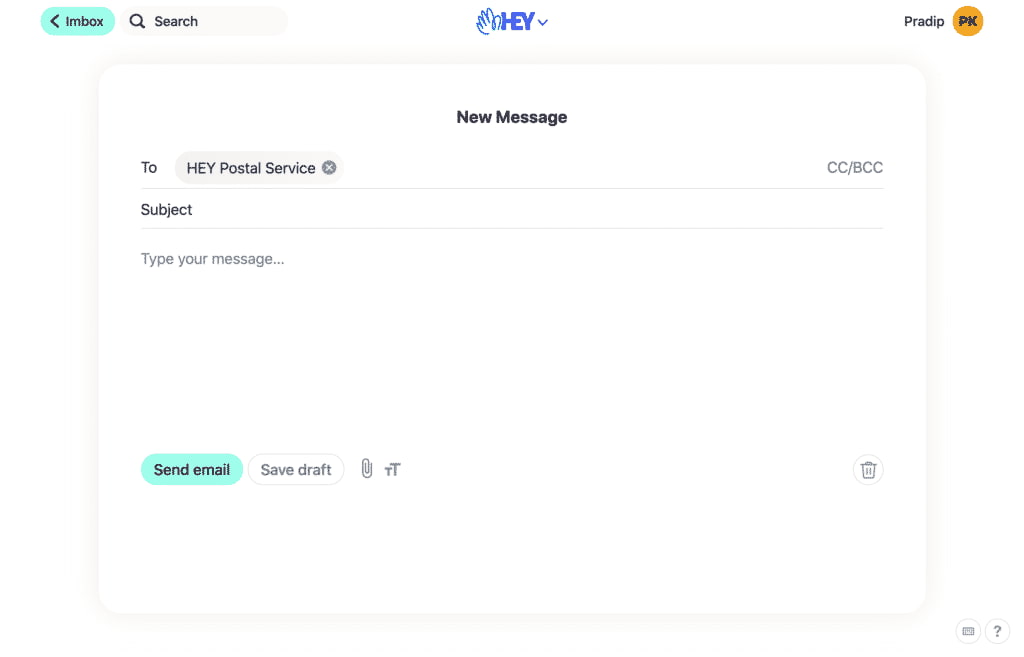
Though I am very curious as to what Hey Postal Service is.
Can’t help but think about Slack
I can’t help but think about Slack right now. Slack at one point in time marketed itself as the email killer. HEY is clearly marketing email as a “treasure.”
Under the current iteration, HEY feels very much comparable to Slack, yet its positioned as email. I know it’s email with the Basecamp flavor.
For some reason which I cannot pinpoint exactly. Maybe I’m thinking of Campfire. In 2006, we [Basecamp] built Campfire to help businesses communicate better. It’s a simple, real-time web-based group chat tool that lets people set up password-protected chat rooms super quickly. Source Basecamp product history.
Could Campfire have become a billion-dollar business?
Was it a missed opportunity?
When I use HEY (for the limited two day’s I’ve been using it), my mind wonders into the Slack territory. It might be because I am customed to thinking email and a calendar go together.
Is it time to change that thinking?
2FA
If you choose to pay the $99 (or whichever tier you choose based on the number of characters in your email) after successful payment you’ll be taken to a page to set up 2FA. Nice touch. I’d be interested in learning how HEY has implemented this feature.
Questions
A few of questions come to mind that I don’t quite know how to address.
Where’s the calendar?
I’m a calendar person. Right now I live and die by the calendar. HEY doesn’t have a calendar. How can I change my workflow or do I need to use a separate calendar app. It totally makes sense if I was using Basecamp as I believe it has some calendar features.
What is the impact on my newsletter?
As someone who has a small but growing newsletter, open rates have never been something I focus on. I’m more interested in people replying to my emails and conversations.
I use Mailchimp for my newsletter and every now and again I look at what stats are available in Mailchimp and one of the stats or options I have is the ability to trim the “inactive” readers. I am not a newsletter/ Mailchimp expert, however, from what I understand this is calculated using open rates. How will this feature work going forward?
As I mentioned earlier, I have no interest in the open rates, however, will I end up paying for contacts in my newsletter list that don’t actually open my emails and continue to receive my emails. Will this drive them to flag it as spam in Gmail?
Or will this impact my deliverability and my ability to land in the inbox or Imbox?
Newsletter advertising?
I don’t advertise on my newsletter however, many other people do. In a telegram group Paul Metcalfe and I are a part of. He discusses the above impact on his newsletter and also added advertisers want to estimate ROI based on how many people are going to see the ad and track conversions on who did see the ad (impressions > click > conversions).
Paul totally understands that people who receive emails might not want to be tracked so maybe it’s something newsletter owners need to be proactive about and find solutions to.
What’s on the roadmap?
While I did not find an “official” roadmap, I believe that custom domains are on their roadmap. Meaning in addition to sending an email from say pradip@hey.com you’ll also be able to send emails from something like pradip@theproductangle.com. I’m going to go on a limb here and say that to add a custom domain you are looking at additional costs.
Integration with Basecamp?
I’d love to see a deeper integration with Basecamp. I used Basecamp in the early days, however, when pricing moved to $99 per month. A fantastic deal for a small team, however, for just one person it was overkill. I recently tried Basecamp again as they launched a free tier. I really like basecamp.
Basecamp even has a “Hey” section in the header. Could we see a deeper integration? Could Basecamp and Hey be the *only* tools you need?
HEY vs. Apple
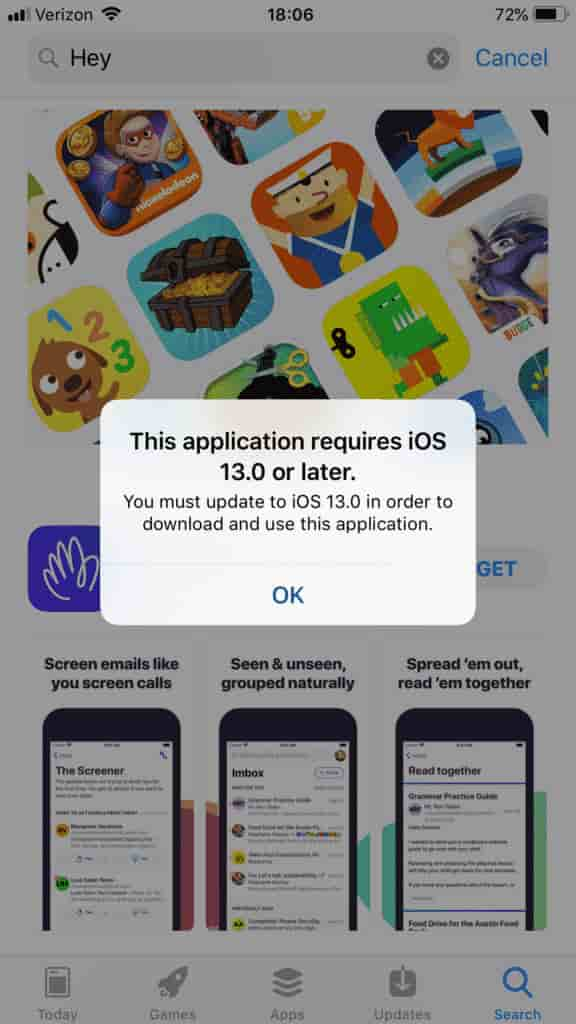
Upfront disclosure here, I’ve yet to download the HEY IOS app. I’m currently using an iPhone 8 Plus, it does the job and I’m running IOS version 12.1.2. The HEY IOS app requires IOS 13 and above.
Do I upgrade and risk slowing my iPhone down? Still thinking about it.
Recently Apple took issue with the HEY IOS app under its guidelines “Apple’s App Store policy, 3.1.1”. I don’t plan to go into it this issue in this article as its not the intent when I started writing this piece (and to be honest I have not had the time to follow the story).
However, it does deserve a mention and I hope both HEY and Apple can put this past them and do what’s right for users and customers.
Apple should absolutely keep improving the App Store, but most of the things listed here are already possible, they just require a bit more work. ¯_(ツ)_/¯ https://t.co/gZ8a19UA84
Let me get this straight…#HeyApp can be opinionated about what's okay and not okay in your email experience, but it's not okay/unfair for Apple to be opinionated in how it runs its @AppStore?
I don't remember when I felt this excited trying out a new web product. This one specifically, is a fresh take on email. HEY puts consumers over businesses with privacy being a 1st class citizen of its ecosystem. 👍🏽 @dhh and @jasonfried. Now keenly waiting to see you defeat apple pic.twitter.com/D6zqmFMy0w
If I circulate my Hey email I’ll be paying Basecamp $99 / year forever.
The tool is nice, their go-to-market was epic, but it’s not nearly game changing enough to warrant that kind of commitment.
— Mark Henderson (getacquired.com) (@MarkJHenderson) June 20, 2020
Marketers thinking how to adjust
Get ready to see some open rates drop…
Not sure that's a good thing for newsletter writers that have the good practice to regularly clean their email lists by removing inactive subscribers 🙄 pic.twitter.com/XZtVQ2zThB
Hey – Is the new email service from Basecamp worth the hype?
From a product perspective, I am inspired by the way the team has rethought the email space. Full credit to Jason, David, and the rest of the team. If anyone has any connections to Jason or David, I would love to chat with them behind the HEY thinking on The Product Angle Show.
For me, the biggest plus point is the rethink of how we should be using our emails. Last year I had over 50K emails in my inbox and I used Leave Me Alone to unsubscribe from unwanted emails and then deleted most of the emails. I figured if it’s important the issue will surface back up.
At the time of releasing this, I’ve only used HEY for two days. Two days is not sufficient to fully make a decision as I’ve not had a chance to use all their features.
Would I pay $99 to keep my pradip@hey.com email? I’m very tempted, I have a great deal of respect for the team and I really want it to succeed. I’d love to follow along the journey at least from the perspective of a customer.
Right now I still have 12 days to decide.
Would I use it as my daily driver? It’s too early to tell right now. I would miss my calendar I have to research and read a little more on how the team intends to fill this void. (maybe a deeper integration with Basecamp? or an upcoming productivity suite?)
Question for you?
What are your thoughts on HEY? Is this something you’d pay for and keep? Let me know in the comments below. Or feel free to send me an email pradip@hey.com
Are you in the market for a new Product Management job? Before you apply update your resume with this sample Product Manager resume. However, if you are not sure where to start continue reading.
Elements of a sample product manager resume
Name
Make sure your name, phone number, and email are clear at the top of the page.
Summary
Create a short paragraph of your career highlights. Make it easy to read and do not use bullet points. The aim of this summary is to highlight your achievements.
I am aware that some people do not think there is value in adding a summary and that’s ok. Though, remember a summary is not an objective statement.
Employment History
Besides the obvious, name of the company, the dates, and a meaningful title. After that, what you did/ your achievements at the company need to be specific and tailored to the job you are applying for.
Hence, we do not recommend having one resume that you blast out to many open positions.
Product Skills
List out the product skills you have. Separate each skill with a comma (not a vertical list). For example:
Discovery: Interviews, Market Research, Competitor Analysis, Surveys, Experiments, MVP, Success Metrics (AARRR), User personas and Storytelling, Messaging, User Journey, negotiation, process improvement, and feature optimization.
Editable template & review
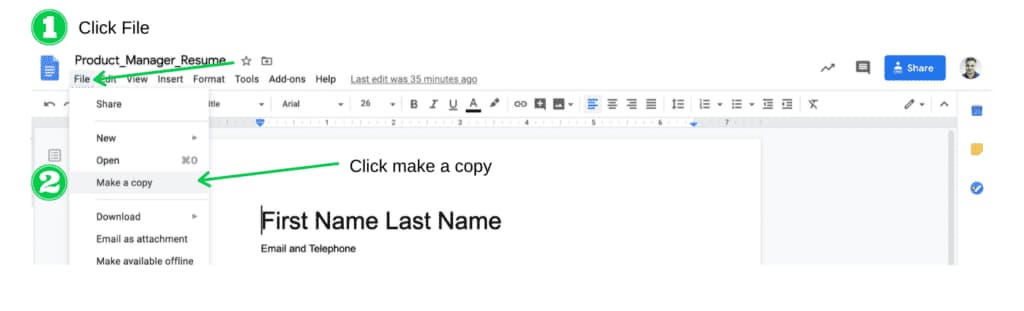
As a Live member, you’ll get access to the remaining elements, access to an editable Google document template, and feedback on your resume. To create your own copy:
1. Click File
2. Click Make a copy
3. Edit
Today Monday, June 01, 2020, was scheduled to be day 1 of 6. Please read our Statement on Summer of Product.
Please read Statement on Summer of Product.
Dear friends,
We are postponing Summer of Product. We don’t have a future date planned as of yet, but it will happen.
When we canceled Product Impact 2020, we all had a common enemy – the coronavirus. The coronavirus brought the world to a standstill, many people faced adversity, loss, and the fear of the unknown. Since then the world came together in support of each other. In a way, it brought us together.
This time it’s different. This time the country is divided.
The actions over the last few weeks are incomprehensible; the killing of George Floyd in Minneapolis, Ahmaud Arbery in Brunswick, and Breonna Taylor in Louisville, Kentucky.
This past weekend I have seen firsthand friends, families, and neighbors in distress. To be honest, I don’t really know how to process this right now. Living in NYC I am minutes away from the streets that I know and love, seeing them in this light deeply upsets me.
When I first immigrated to the US, I was very excited. I considered myself very fortunate to have this opportunity.
Today things are different – mass shootings, racism, twitter feuds, lack of direction/leadership, etc.
I feel sick just writing this.
What does 2040 look like?
I received an email from my alma mater which quoted former President Obama:
“When incidents like this occur, there’s a big chunk of our fellow citizenry that feels as if because of the color of their skin, they are not being treated the same. And that hurts. And that should trouble all of us. This is not just a black issue. It’s not just a Hispanic issue. This is an American issue that we should all care about. All fair-minded people should be concerned.”
And former President Obama is right. The problems that we must confront belong to all of us. Therefore, we need to own up to them. We have to own them. All of us. Their solutions also need to be owned by everyone, but especially by our leaders and those in positions of authority and influence.
In this episode of The Product Angle, we chat with Neeraj Mathur. We chat about how to land your next role if you’ve been laid off. Or about to be laid off.
In this episode of The Product Angle, we chat with Sergio Mattei – founder of Makerlog. We chat about his vision and roadmap for Get Makerlog and Sergio shares exclusive roadmap and vision details he has never shared before.
In this episode of The Product Angle show, we chat with Fabio Rosado. We chat about his journey learning to code and Fabio launches his new product live on the show.