From Cirque to UX with Justine Benoit

In this episode of The Product Angle show, from Cirque to UX. We chat with Justine Benoit about her journey from being an automation technician at Cirque du Soleil to becoming a user experience designer at BigBear, Inc.

By the end of the episode, you’ll learn about:
– How to transition your career to User Experience
– Tenets of good human-centered design
– Building Products that people love

From From Cirque to UX with Justine Benoit

About the guest

Justine is a user experience designer on a mission to create a meaningful impact in people’s lives with a Bachelor of Science in Entertainment Engineering and Design.

However, before becoming a full-time designer, Justine worked as an Automation Technician at multiple Cirque du Soleil shows including The Beatles’ LOVE and Mystere.

Key Takeaways

In this episode, Justine shares how she transitioned from an automation engineer to a user experience designer. The role of design is so important, designers need to be mindful of people, and the environment.

Find out what should you expect and what skills you should focus on building? One notable mention is the ability to communicate and negotiate your design decisions.

Justine made some time to answer some fantastic questions from the audience. Such as how to create a portfolio if you a junior designer. Justine has some fantastic tips to create an effective portfolio that can help you land a new job.

Books mentioned by Justine.
1. The design of everyday things by Don norman
2. The social animal by David brooks

Show Timestamps

05:15 – Transferring skills from automation engineering to UI/UX.
19:20 – Differences in the two roles and skills you’ll need.
24:00 – Things to consider if you are thinking of transitioning into UI/UX design.
36:00 – How the design team works with the product team.
41:00 – The importance of customer support, sales, and marketing.

Show Links

Read Justine’s work over on Medium.
Listen to other episodes of The Product Angle Show here.

Building Products is More Than Just Features

Building products is more than just features. In this article, I share some of my learnings and experiences building products.

First, here’s a quick definition of what a product roadmap is so we’re all aligned. A product roadmap is a shared source of truth that outlines the vision, direction, and progress of a product over time. It’s a plan of action that aligns the organization around short and long-term goals for the product, and how they will be achieved.

Before we jump in, let me introduce myself, my name is Jonathan Poor and I’m a Product Manager with experience in Strategy and Innovation consulting for the past 5 years.

I have launched three client-facing products at Quesnay and Tunity. Over my career, I have drafted multiple product roadmaps, designed wireframes, and led customer interviews.

Starting your product career

Picture this situation: it’s your first day on the job (woo!). Your boss approaches you mid-day to start working on your first product roadmap. Excited and full of enthusiasm, you dive right in. However, where should you start?

Your boss gives you a list of features the team and upper management want to develop ASAP. Logically should these come first? After digging in, you discover the feature list includes ad-hoc requests from various managers in sales and customer success.

You realize no one talked to the users to understand their needs, what problems they are looking to solve with your product, or how these features align with your company’s overall strategy.

A situation like this smells like a recipe for disaster to me. If you decide to execute the current roadmap, you’ll probably find yourself reacting to requests. Which is different from what your role as a Product Manager is. As a Product Manager, you need to understand the user’s needs and together with the team to build solutions that solve their problems, create value for them, and drive business value.

Building products is more than just features

So what should you do? How can you create a solution that is aligned with your strategy and solves real problems your users are experiencing?

Here is a list of recommendations based on my experience.

Strategy first

The first thing you need to do is align the product with your company’s overall strategy and mission. At Quesnay, we wanted to help different participants of our innovation competitions connect post-competition. We aligned on this strategy because it fits our company’s mission of connecting startup founders with corporate executives and VCs for investment, proof of concept, and partnership opportunities. With this understanding, we were ready for the next step. But don’t forget – talk with all relevant internal stakeholders to understand if they are aligned with the strategy before moving forward!

Define your users and the job they want to get done

You’ll need to understand who will use your product and why they need it. Luckily for us, we already knew who our users were. Using this information we knew that post-competition our users were interested in keeping in touch and interacting with others before the next competition. We, therefore, needed to discover various ways how to help them do this.

Talk to your potential users

Now you have an understanding of who your users are and have an understanding of the job they want to get done. Let’s not assume anything. It is important to talk with the users to understand how you can help achieve their jobs to be done.

Use user interviews to understand how your users currently get this job done and why it isn’t working for them. Notice at this time, you should not have written one line of code. Nor any features are committed. We are still in the discovery process and are trying to lock-in on the problem we want to solve.

Another benefit of talking with potential users at this stage is to acquire a curated group willing to help with prototype testing once you are ready. My suggestion is to aim for 5 user interviews per user profile. This number will allow you to start seeing patterns and move quickly. More than 5 is okay, but the ROI on time invested is diminishing from that point forward.

Wireframes and mockups

Using the information you collected you now have some pretty solid data to start thinking about building your product. Based on the user interviews and the data you collected, you can prioritize features and create mockups.

For each feature: create a user-journey, a storyboard, and a wireframe. Using your wireframes, you can build a fully functioning mockup using Sketch and InVision. If you don’t have access to these tools, Keynote is a quick and dirty way to build a very reliable mockup. Note: Some companies may have a dedicated designer (or team) to create your wireframes.

Test, iterate, build and launch

With the mockups created, set up additional user interviews to see if the mockup you’ve built functions properly and if it solves the problem you identified. This gives you an opportunity to let early adopters access and you gain vital information around the user experience.

If you need additional users, feel free to contact people from your target audience and include them. Again the magic number of user tests in my opinion is 5, so conduct 5 tests, analyze the data, make changes, and test again as necessary. Once you feel comfortable with your mockup, it is time to build your product.

Continue iterating

After you build and launch your product, you should continue talking with your customers, testing, and iterating. By doing this, you can continuously update your roadmap with impactful features that align with your strategy and answer your users’ unmet needs. It is recommended to have a cadence of check-ins with all relevant stakeholders to keep them informed and establish clear communication channels.

That’s it from me for now, but if you would like to connect to talk about product strategy and creating impactful product roadmaps shoot me a message. Best of luck on your Product Management journey.

10 Product Management Skills to practice in 2021

Over the last few years, Product Management has exploded. From startups up to fortune 100, companies are seeing the positive value a product manager can bring. As a result, more people are choosing to become a product manager. In this article, I look at 10 product management skills to practice in 2021.

What is a Product Manager?

The reality is that the role of the product manager varies based on a couple of factors. For example, the size and maturity of the organization and the industry. A product manager working at a health insurance company or at a financial institution such as a bank will have similarities and differences between a product manager working at a software streaming service or at a data center software company.

We recently chatted with two product managers and compared and contrasted the different aspects of their roles in an episode of The Product Angle Show. Watch the episode here.

However, having said that, I think the product manager needs to be able to:

  1. Discover and communicate the product
  2. Collaborate with the team to execute
  3. Repeat step 1

In addition, we often hear phrases such as “build products people love” and “build products people need” which are fantastic. However, we have to also remember that to be sustainable the product needs to bring in revenue and meet business goals.

Therefore, my take is to “build products that people buy and use.”

Build products that people buy and use Share on X

10 Product Management Skills to practice in 2021

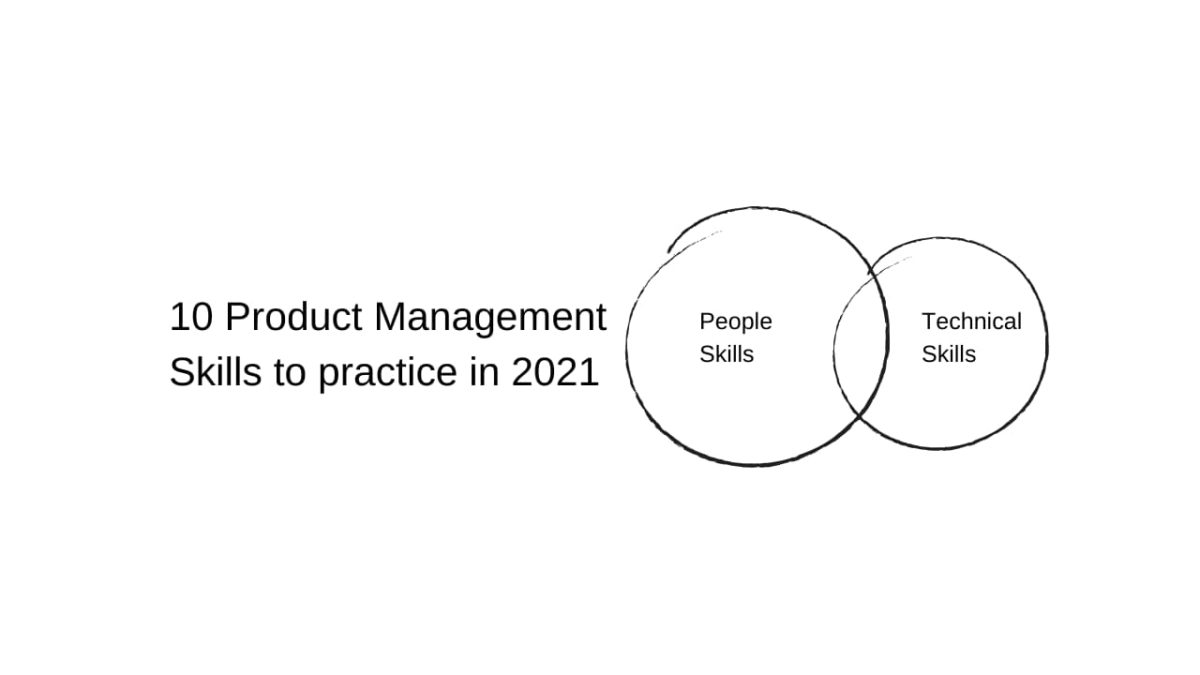
The skills below are listed in no particular order. However, you’ll notice from the graphic that I make the distinction between people skills and technical skills. Both complement each other, although I am biased towards people skills. Much literature, courses, and focus is placed on technical abilities. However, in my opinion, in reality, people skills are what takes your product and your career to the next level.

1. Lead by influence

As a product manager, you’ll have a tremendous amount of responsibility. However, zero authority. You’ll need to be able to persuade, influence, and negotiate effectively internally and externally.

You’ll be saying no frequently. Saying no to the sales team can be difficult especially since the sales team can provide:

  • Visibility into the context of lost deals (features, pricing, or competition).
  • Information around customer questions and issues.
  • Access and warm introductions to prospects and customers.

Sometimes these conversations can become heated and therefore you’ll need to manage conflicts and difficult conversations.

2. Build Trust

Without authority, you need to get your team and potential customers excited about your product. Trust is something very easy to lose yet, very hard to earn.

Trust takes time and consistent showing up to build. However, Trust, like love and happiness, is difficult to explain in clear, rational terms. Two of my authors around building trust are Guy Kawasaki and Robert F. Hurley. Both authors talk about trust in their books, I’ve summarized here and here.

3. Customer Research

As Katelyn Bourgoin says “Companies that invest in ongoing customer research grow 2-3X faster. Yet, studies show that only 3 out of 10 teams do it regularly — crazy, right?”

The biggest pushback I’ve heard is that “we don’t want to bother our customers, they are paying and we don’t want to give them a reason to look elsewhere.”

I was at a loss for words when I was told that. After recomposing myself, I asked how do we determine the direction of the product if we don’t talk to the customers?

Another push back I’ve seen (and this is generally from first-time founders) “Customers don’t know what they want if they did the iPhone would never have been invented. Nobody wanted an iPhone.”

To be clear I’m not saying you should listen to and do everything a customer says. However, I am saying:

  • Understand what they are trying to accomplish.
  • Know what success looks like to them.
  • Understand their thought process before they bought your product.
  • What are their Jobs to be done.
  • If they bought or tried a competiting product, ask why, what worked and what could be improved and why.

As a product manager, you need to be talking to users/ customers/ and potential customers as much as possible.

4. Ability to look at the bigger picture

Does every decision made for your product in some way help achieve two things: 1) add value for the customer and 2) Drive business value?

This becomes possible if you have a clear product vision, strategy, and roadmap to execute.

As new information is available you may need to adapt and make new decisions that might take the product in a different direction.

However, you’ll need to take into account the available data and make decisions that drive the product within the constraints.

5. Sales

Let me be very clear here, as a product manager you do not need to sell. However, as a product manager, you need to understand the buying process of your user/ customer. As someone who has spent years selling, the skills you’ll learn are invaluable. Julian Osterwalder agrees with me.

At an enterprise level, the sales cycle can take anywhere from six months to twelve months. Whereas at a consumer product where switching costs are relatively lower, the sales cycle is much lower. The selling skills and how customers buy will be different.

Retention at an enterprise is higher possibly because of the high initial switching costs. Hence, the longer the sales cycle.

Retention at a consumer might be lower possibly because of the low switching costs. Hence, the shorter the sales cycle.

In addition, product managers need to learn to sell internally as well. As product managers, you’ll need to sell your vision and strategy internally. Especially to engineers.

6. Communications Skills

Communication, collaboration, and negotiation is the cornerstone of the role of product managers, in my opinion. We need to communicate with internal and external team members.

Communicating effectively will facilitate a better understanding of people. Helping build trust, find solutions for conflicts, and create a healthy working environment.

Every team member will have their preference of how they want to be communicated with. However, at a basic level, you’ll need to:

  • Write emails
  • Document various product learnings and documentation
  • Create presentations
  • Prepare and run meetings
  • Slack style communications

7. Storytelling

Since I’ve mentioned communication as one of the 10 Product Management Skills to practice in 2021, to take communication further. Communication can create noise, if not done appropriately. Think about that one person who sends you an email for nearly everything. I once worked with a colleague who would reply to every email with the word “noted”.

Storytelling can help you cut through the noise and connect with your audience, internally and externally. For example, a presentation becomes more engaging if it tells a story versus 2 facts on every slide.

While facts are important for example, monthly active users. However, knowing why they use the product or what they’ve achieved using the product connects at an emotional level. It puts the users at the center.

Finally, stories are easier to remember.

8. Understand Tradeoff’s

As Jeroen De Flander’s quote appears in April Dunford’s Obviously Awesome book. You cannot be everything to everyone. If you decide to go north, you cannot go south at the same time.

Product Tradeoff needs to be made to serve your target user. As a product manager, you’ll have access to quantitative and qualitative data. You’ll need to be able to go through the data and make decisions that shape the direction of the product.

9. Prioritization and Sequencing

As a product manager, feature requests will come at you from multiple directions. Externally from customers, and internally from multiple stakeholders including sales. Each will require you to go in different directions.

Prioritization techniques help you evaluate different ideas and the amount of work needed to ship those ideas. Therefore, hopefully reducing waste and working towards a product that creates the most impact for your users.

Expect priorities to shift, as budgets are cut, resources leave, and even consumer tastes and preferences change. However, based on the constraints prioritization can help you answer:

  • What has the biggest impact on the users.
  • How does this impact our business goals?
  • Are we continue to add value while keeping within our strategy/ vision?

Intercom has written about Prioritization:
RICE: Simple prioritization for product managers,
The first rule of prioritization: No snacking, and
Prioritizing Features: Who’ll Use It & How Often?

Prioritization is something that gets a lot of attention. Sequencing, in my opinion, is more about reprioritizing based on how fast the user can get to the desired outcome, and therefore, the product is adding value to the customer (as fast as possible).

10. Ship that Product

Finally, every product manager needs to be able to get shi*t done and ship that product. To be clear we need to ship products that people want to buy and use. Products that add value to the user and solve a challenge in their lives.

Practice not read

Product managers are active learners and as such, you can read about any of the above-mentioned skills. However, to really understand the skill you in my opinion need to take a three-step approach to learn and learning by doing.

  1. Absorb the information (read, listen, and watch) materials
  2. Practice those skills in a safe environment
  3. Talk about the nuances with your peers and experienced product managers

Now, I am not suggesting you go and spend a large sum of money on courses and coaches. Read If not Courses and Coaches, how else do I learn Product Management? I like Sugandha’s take. Certain skills cannot be taught by reading books. As a product manager, you need to develop curiosity. Be aware of product trade-offs and decisions made.

For example, Instagram recently changed the position of reels in their app. Find out why, talk to other product managers, understand the experience and tradeoffs. This curiosity is going to take you further than any course.

However, if you are someone who needs structure and access to peers and experienced product managers, we are offering a 4-week online cohort-based course where you’ll learn step-by-step strategies and tools to build alignment in your team.

Accelerate your career by learning to influence, communicate, coach effectively. Confidently say no, give & receive feedback, learn how to have those difficult conversations, and manage conflict while building trust within your team.

How To Be Intentional With Your Time

In this episode, How To Be Intentional With Your Time (even while working remotely) we chat with Corey Fradin. Corey is the founder of QuickBooost. Corey brings his passion for planning, productivity, and goal setting. Learn as we chat about how Corey is able to get more done in the day.

You can still be productive with your time even though your boss isn’t hovering over your shoulder. Here is how to be deliberate about your day-to-day.

By the end of the episode, you’ll learn about:
– Becoming more productive so you can get more done
– Setting goals effectively

How To Be Intentional With Your Time (even while working remotely)

About the guest

Corey Fradin is the founder of QuickBooost. Corey helps his clients do more with their time, productivity, time management, goal setting, and more. As well as how you spend your time and where you spend your attention. As a result of thoughtful decisions, you can cultivate a life of meaning, purpose, fulfillment.

Key Takeaways

Goal setting is something we’ve all done at some point. Think about the typical weight loss goals we created in the new year. Unfortunately within two weeks, many people give up.

Corey shares his knowledge and expertise to create goals that are manageable. In addition, Corey shares his wisdom and actionable steps to be more intentional with your time allowing you to achieve more.

Setting goals that are in your control.

Show Timestamps

01:05 – Corey shares something that we cannot Google about him
03:07 – What is a goal and how to create them
12:40 – How motivation fits into the goal-setting strategy
14:44 – What is time management and productivity?
19:07 – How to define success

Show Links

Follow Corey over at QuickBooost.
Free Goal Success Ebook & Checklist here.
The The Definitive Goal Success Course here.
Read 3 Tips To Make “Anywhere” Your Productive Workplace, also by Corey Fradin.
Listen to other episodes of The Product Angle Show here.

We Are All Designers

We are all designers. Designers are the most equipped to create meaningful change through our craft. In this article:

  • I am going to share some light on what it means to be a designer.
  • How we are all designers in our own way.
  • How we can use our collective powers in creating for the good of humanity and our planet.

A designer is commonly known as someone who creates beautiful things. However, design spans far beyond creating beautiful things. Many fail to recognize the science, compassion, collaboration, and thoughtful work behind the finished product.

Design is creative problem-solving

The most innovative minds will solve the most complex problems. What is innovation but a product of creative problem-solving.

Designing isn’t limited to the person who has “designer” in their title. As Jared Spool said in a recent episode of the User Defenders Podcast, “Anybody who influences the design is, in fact, a designer”. That includes developers, architects, engineers, product managers, and everyone else involved in the creation of a product.

Design is a collaborative effort. The UX and UI designers might take charge of the experience and aesthetic of a product, however, there is also a team of engineers designing the implementation of that product. A product manager designing the roadmap to create and shipping that product, as well as a team from marketing and sales designing a strategy to advertise and sell that product.

The Interaction Design Foundation recently held a master class on 21st Century Design with Don Norman. In it, Norman stated that designers in the 21st Century are the most equipped for creating impactful change.

Our responsibility

As designers, we have a duty to create things that will nurture, improve, and protect our planet and humanity. Now more than ever, we need to stay vigilant and consider the consequences of our design to the environment and to society.

However, as designers, we must:

  • Learn to keep an open mind.
  • Be open to learning from other disciplines.
  • Bring them all together in our creative process.
  • Learn to focus on people and to solve the core issue.
  • Also, we must also learn to respect and value everyone’s point of view.

Finally, we are all designers. We all need to aspire to become good designers in order to create things for the good of our planet and humanity.

Justine will be on The Product Angle Show on December 02, 2020 at 12 noon ET to watch live register for your free ticket here.

How to get started in Product Management with Shrinedhi Rajan

In this episode how to get started in product management with Shrinedhi Rajan. Shrinedhi shares her journey to becoming a product manager.

By the end of the session, you’ll learn about:
– How Shrinedhi started in product management out of college.
– Steps you can take to land your first product manager role.
– Interview best practices.

How to get started in Product Management with Shrinedhi Rajan

About the guest

Shrinedhi is a product manager at PointsBet. A Chapter lead at Products By Women. She recently graduated with a master’s from Cornell University. Shrinedhi records podcasts on product management, and diversity and inclusion.

Key Takeaways

First, do you want to get started in product management?

There are *a lot* of resources out there. What do you read/ listen to?

How about learning from someone who did exactly that recently (not years ago).

Job search is difficult, especially considering COVID. However, the hiring season is back in session and so are the opportunities to break into product management.

Shrinedhi shares her experiences at Cornell University. Sharing her learnings and preparation to pursue a career in the product space.

Also, Shrinedhi breaks down her presentation:
– What is product management and after that
– Importantly understand if the role is right for you.

In conclusion, Shrinedhi loves sharing various quotes as you’ll see throughout her presentation.

Show Timestamps

01:20 – Shrinedhi shares something that we cannot Google about her.
03:20 – Start of Shrinedhi’s presentation.
10:00 – The multiple hats product managers wear.
22:10 – Creating your path into product management and the interview process.
44:43 – Finally, Q&A with Shrinedhi.

Show Links

Follow Shrinedhi on Linkedin.
Listen to other episodes of The Product Angle Show here.

Founder Stories: Getting Ready to Launch Taggg

Hi there, I’m Trevor 👋 I’m one of the founders of Taggg. In this article, founder stories Q&A getting ready to launch Taggg we go behind the scenes. We’ll share how we are building and thinking about a go-to-market strategy for Taggg.

What is Taggg and who are the founders?

Who are the founders of Taggg?
Nichole, Aaron, and I are the three co-founders.

How did you all meet?
We met organically through working together on different SaaS projects and growing our client’s products together.

What are the roles you all play in creating Taggg?
We each wear many hats as you can imagine, however, we could group our primary roles as:

  • Aaron takes on user onboarding and customer engagement.
  • Nichole takes on the acquisition and getting the word out right now.
  • Trevor is the product manager and technical advisor and works directly with the development team.

What is Taggg?
Taggg is a software specifically designed to make scheduling group meetings easy.

The Ideation Phase

Who came up with the idea for Taggg?
It is my concept and was born out of the constant issue of scheduling meetings with clients, the Inturact team, and 3rd party contractors that each have different calendars and oftentimes use different calendar software.

Walk us through the thinking behind the problem/ creating value for users?
We leveraged the JTBD framework to uncover unmet needs within the space and come up with the top 3 needs in the space to concentrate our initial product development around:

  1. Minimize the effort when deciding what meeting times to suggest to multiple people
  2. Reducing the time it takes to reschedule canceled meetings
  3. Minimizing the effort to schedule meetings from your mobile device

As of now, we are concentrating wholly on #1 we will work on #2 and #3 after finalizing the core of the product with #1. We are solving this problem by leveraging what we call “calendar overlays” and letting multiple users see availability overlaid against their calendar to find times to meet that work for all parties.

What does customer discovery look like?
The biggest effort went into the initial JTBD research, but we also will be leveraging Canny.io for collecting feedback and InnerTrends.com to make data-driven growth decisions within our customer data.

Competition

How much emphasis/ thinking went behind competitor analysis (who are the competitors)
Believe it or not, we tried to ignore most of the competition. There are a ton of competitors in this space such as Calendly or Doodle. We think everyone has looked at scheduling in the same way and that is why so many tools function alike.

However, we have completely rethought what it looks like to schedule meetings from the top down. Meaning, we want to solve being able to schedule group meetings with multiple people first, and then solving for 1:1 meetings becomes simple. When you first frame solving for scheduling meetings in this way you begin to realize how many gaps there is that need filled in this space.

Roadmaps

What is a roadmap to you as founders (purpose and goals)?
At a high level, our roadmap aligns directly with our unmet needs:

  1. Minimize the effort when deciding what meeting times to suggest to multiple people.
  2. Reduce the time it takes to reschedule canceled meetings
  3. Minimizing the effort to schedule meetings from your mobile

We will be working through numbers #2 and #3 as soon as we prove value with #1.

How do you go about getting alignment and buy-in for roadmaps?
Again this is primarily based on talking to our ideal customers and understanding their unmet needs at this early stage. However, once we have customers it will be driven by new customer research still, but we will also look heavily into our user data to start to make data-driven growth decisions and build our roadmap based on customer engagement analytics within the product.

The Build – Founder Stories: Getting Ready to Launch Taggg

This has lived in my head for a while. We this something that people need from the start, however, we still backed up the hypotheses with research and actually uncovered insights that changed the direction of the product in regards to prioritization of features.

Talk us through what Alpha, Beta, and MVP mean to you?
We look at Alpha as our very close private network giving us feedback on our product. Then we look at Private Beta as a slightly more extended network of ours and from our private network.

Next, we will then move into a Public Beta stage as the first iteration that anyone can join the product. An MVP comes prior to all of these stages and we look at it in two parts. The first part is a clickable prototype. This is a low-cost way to make sure the concept is worth pursuing. From there you create the actual MVP which to us is a bare-bones product that concentrates on functionality over UX or UI

Founder Stories: Getting Ready to Launch Taggg

Walk us through the go-to-market strategy
W have a waitlist of 150+ people right now and have not been pushing this too hard as we have a very large network between the 3 of us. It is somewhat of an unfair advantage. We wanted to make sure we had a way for people truly interested in solving this problem to get early access as well though.

As of now, we will be in Alpha within our close network in November or December and private beta to our waitlist is looking like the beginning of 2021 at the moment.

Links

Check out Taggg.
We were recently on The Product Angle Show listen to our episode here.

Scheduling Group Meetings with the Taggg Team

In this episode of The Product Angle Show, we talk to the founders of Taggg Meetings about scheduling group meetings. Nichole Elizabeth DeMeré, Trevor Hatfield, and Aaron Krall as they share their journey creating Taggg. The product thinking behind the product and onboarding their first users.

By the end of the episode, you’ll learn about:
– How the Taggg team was formed.
– Taggg’s approach to user research.
– Onboarding Taggg’s first users.

Scheduling Group Meetings with the Taggg Team

About the Guests

Aaron Krall helps SaaS companies drive more leads, convert more users, and accelerate growth. His proven, done for you systems and frameworks have increased conversions, automated sales, and reduced churn for companies like Reply.io and IBM.

Aaron runs the largest SaaS community in the world: SaaS Growth Hacks on Facebook. He lives in Salt Lake City with his wife Natalie, his son, Arlo, and dog Penny. He enjoys reading horror movie synopsis on Wikipedia and leaving funny reviews on Google Maps.

Trevor is a serial entrepreneur and investor. He is the founder of Taggg and also owns Inturact, a B2B SaaS growth agency, and is the head of growth at InnerTrends, a SaaS product analytics software.

Nichole is a B2B SaaS Consultant, Nichole takes startups from problem/solution fit to product/market fit, all the way through growth marketing to scale. Nichole’s specialty is in quickly diagnosing strengths and weaknesses in SaaS companies and strategizing ways to improve retention and strengthen brands. To share some of Nichole’s experiences, Nichole along with Trevor is writing a book about B2B SaaS. Nichole was unable to join us today.

Key Takeaways

We go behind the scenes to learn how the Taggg co-founders came together to create value by making scheduling group meetings easier. You know when you need to schedule a call with three or more people, it’s a pain.

We chat about customer discovery, competitors, communications, as well as roadmaps, and go to market strategy.

Show Timestamps

01:10 – Trevor and Aaron share something that we cannot Google about him.
03:05 – How the founding team came together.
04:00 – What is Taggg and what Taggg does.
28:10 – Taggg’s go to market strategy.
37:15 – What the future looks like for Taggg.

Show Links

Check out Taggg.
Follow Nichole on Twitter.
Check out Aaron on Twitter.
Follow Trevor on Twitter.
Listen to other episodes of The Product Angle Show here.

UX Teardown of InVision with Simon McCade

In this episode of The Product Angle show, we do a UX teardown of InVision with Simon McCade. Simon helps SaaS companies get more paying customers through better user experience design. Also, InVision is the digital product design platform powering the world’s best user experiences

By the end of the episode, you’ll learn about:
– Good design and areas of improvement.
– How product people and UX designers can work together effectively.
– How to get into design.

UX Teardown of InVision with Simon McCade

About the guest

Over the last 10+ years, Simon has worked with many SaaS companies, large and small, been featured in several online publications including UX Planet and UX Collective, and built a successful product design consultancy.

Key Takeaways

User experience design is so important and has a direct impact on business KPI’s. For example, user retention, driving engagement, and boost revenue by trial success).

User experience design also has internal benefits such as reducing development time.

UX and UI are both crucial to the success of your SaaS. UX is the experience within the product. For example, how the user feels and how easy to accomplish tasks. UI is the overall look and feel of the product. For example, the visual elements.

Show Timestamps

02:00 – Simon shares something that we cannot Google about him
03:00 – How Simon got into design
04:50 – What is UX (and the difference between UX and UI)
07:20 – Introduction to Invision and UX teardown of InVision
41:20 – Q & A with Simon

Show Links

Follow Simon on Linkedin.
Listen to other episodes of The Product Angle Show here.

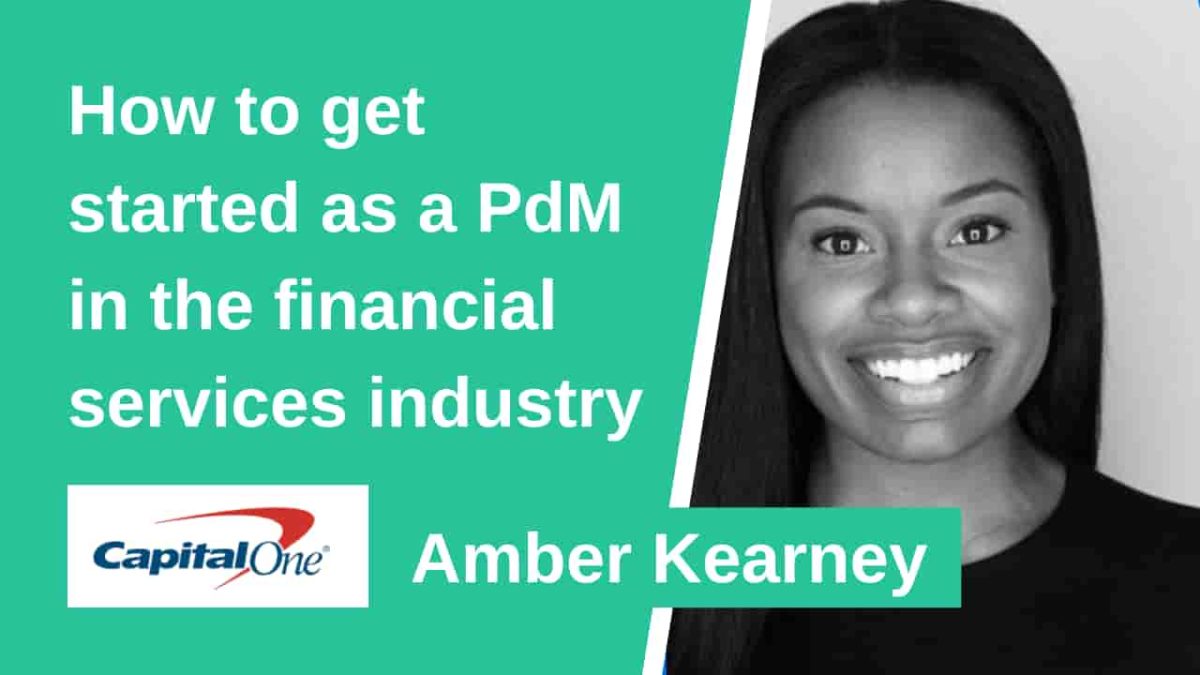
Product Manager in Financial Services

In this episode, how to get started as a product manager in the financial services industry we chat with Amber Kearney.

By the end of the episode, you’ll learn:
– How Amber got started in Product Management.
– What it’s like working as a product manager in the financial services industry.

How to get started as a product manager in the financial services industry

About the guest

Amber Kearney is a product manager at Capital One. Before that Amber worked at Deloitte as a product manager. Amber is also experienced in various account and marketing roles. Also, one interesting fact I found out is Amber learned to speak Mandarin.

Episode Key takeaways

As a product manager, you’ll do all the normal things a product manager is expected to do. However, the regulator plays a role as a stakeholder (or team member).

Generally speaking, the regulator has more leverage than traditional stakeholders (or team members). So, it is important to work closely with the regulator.

Amber shares three nuances.

First, maintain a relationship with regulators. Keep an open line of communication. Regulators, users, and business stakeholders all play a role in how you prioritize and what features you build as a product manager.

Secondly, innovate responsibly. We build products that disrupt the traditional banking or financial model using new emerging technology in a responsible way. It is important to maintain regulator empathy.

Thirdly, the role of controls and risk management. Things unfortunately happen. However, it is important to perform a root cause analysis and remediation. Also, what controls do you have in place to prevent it from happening again?

Finally, I also got the opportunity to ask Amber other product questions such as:
– What is a roadmap?
– Getting alignment and buy-in?

Plus Amber made my day by stressing how important collaboration and negotiation skills are.

Episode timestamps

01:14 – Amber shares something that we cannot Google about her.
04:12 – How to get started as a product manager in the financial services industry.
05:20 – Amber’s journey to tech in financial services.
12:15 – Three nuances for working in regulated industries.
23:00 – Q & A with Amber.

Episode links

Follow Amber on Twitter or Linkedin.
Listen to other episodes of The Product Angle Show here.